
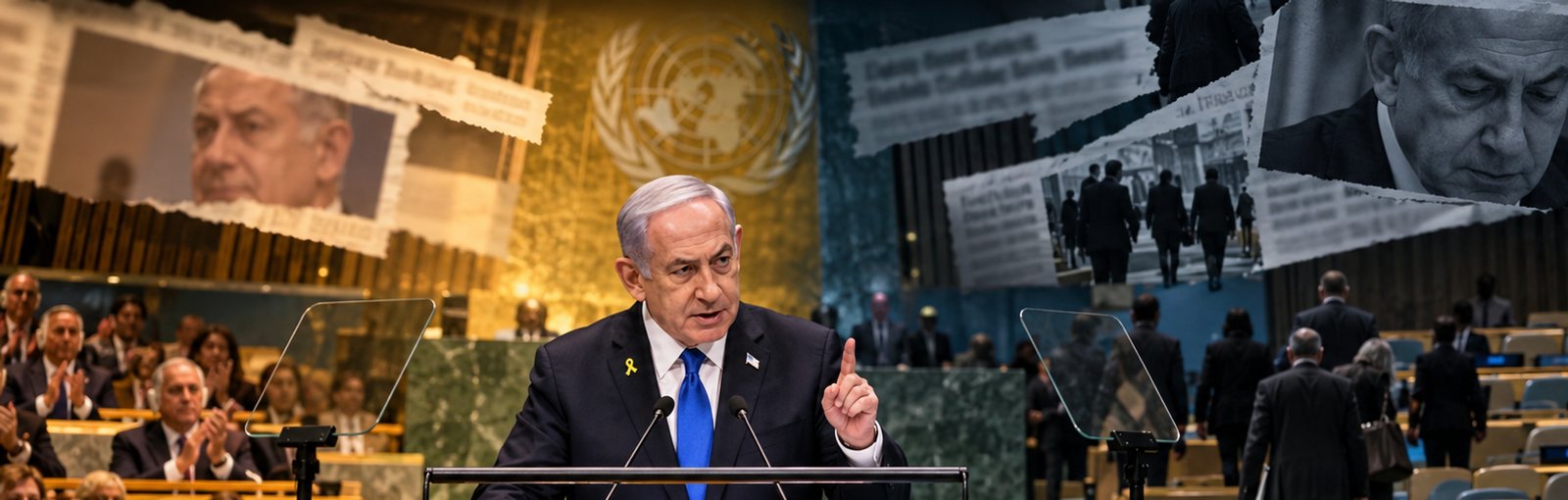

Benjamin Netanyahu’s speech before the United Nations was already political theater before he opened his mouth. Dozens of delegates walked out as the Israeli prime minister approached the podium. Netanyahu called those leaving “moral cowards.” He defended Israel’s wars and denied claims of genocide. He criticized many opponents. This included European leaders and New York Mayor Zohran Mamdani. Fox News called his answer a “fiery response.” Al Jazeera described Israel’s war in Gaza as “genocidal.” The same speech quickly became several different stories depending on who told it.
The disagreement was not simply over facts. Much of it concerned which facts were highlighted. It also involved which facts were left out and the words used to connect them. Fox focused on Netanyahu's defense of Israel and his clash with the delegates who left. Al Jazeera and Middle East Eye highlighted the walkout. They reported on the arrest warrant for Netanyahu. They also mentioned the accusations against Israel. Reuters reported before the speech that Netanyahu intended to confront Mamdani. Mamdani has called Netanyahu a war criminal and has accused Israel of genocide. Netanyahu, in return, accused Mamdani of supporting Hamas.
Those differences matter because Netanyahu was not speaking in a political vacuum. Israel is five weeks from an election. This makes his domestic political position relevant. However, context and conclusion are not the same. Reporting that Netanyahu faces voters soon is a fact. Saying the speech's true purpose was his political survival is just an interpretation. It needs evidence to back it up.
The same problem appears with the word genocide. Netanyahu rejects the accusation. Mamdani, Palestinian leaders and numerous critics of Israel use it. Al Jazeera went further by describing the Gaza war itself as genocidal. Wording matters here. The court has not yet determined whether Israel committed genocide. Reporting an accusation is different from presenting the accusation as a settled fact.
The opposite problem exists when favorable coverage leaves out facts uncomfortable for Netanyahu. Gaza health officials say over 73,000 Palestinians have died in the war. Israel disputes these numbers. The International Criminal Court warrant against Netanyahu also remains part of the story. Neither fact determines whether Netanyahu’s arguments are right or wrong, but readers cannot fairly weigh the speech if important context disappears because it does not fit the outlet’s preferred narrative.
This is where media bias becomes harder to spot than an outright falsehood. A reporter does not have to invent anything. Selection alone can do much of the work. Put the protesters first and Netanyahu looks isolated. Put his response first and he looks defiant. Call something an accusation and the reader knows it remains disputed. If they present the same allegation as fact, they've already made up their minds.
What the coverage wants you to believe: Depending on the outlet, either a strong leader stood up to a hypocritical world, or a hypocritical world rebuked an accused war criminal. Fox supports the first narrative by airing Netanyahu's words without challenge. Al Jazeera and Middle East Eye back the second. They present disputed claims as facts. They also focus on the protesters. UN News gives Abbas the floor without challenge.
What the facts show: A candidate who was behind five weeks before the election took the world stage. He thanked Trump. He argued with European leaders. He clashed with the New York mayor.
Draw your own conclusion about who he was talking to. A planned protest gave him a chance for a confrontation at home. An American mayor, motivated by his own political goals, became his rival. The confrontation changed neither the legal situation nor conditions on the ground.